

THOS Rupture & Reconfiguration
Table of Contents
INTRODUCTION
PART I — THE MECHANICS OF RUPTURE
CHAPTER 1 — COMPRESSION
How compression forms beneath strong performance.
CHAPTER 2 — RUPTURE
The mechanical conditions that produce rupture.
CHAPTER 3 — CYCLE FORMATION
Relief versus structural reconfiguration.
CHAPTER 4 — RECONFIGURATION MODEL
How containment expands across developmental stages.
PART II — STRUCTURAL RECONFIGURATION
CHAPTER 5 — ARCHITECTURE MAPPING
Mapping routing, authority, and pressure pathways.
CHAPTER 6 — AUTHORITY REDISTRIBUTION
Redesigning decision rights, span, and escalation thresholds.
CHAPTER 7 — REFLEX REWEIGHTING
How stabilization reflexes activate under pressure.
PART III — PERMANENT CONTAINMENT EXPANSION
CHAPTER 8 — CONTAINMENT TESTING
Verifying whether redesigned architecture holds.
CHAPTER 9 — IRREVERSIBILITY
When the previous collapse pathway no longer activates.
CHAPTER 10 — SCALING
Expanding exposure, connection, and velocity after reconfiguration.
CONCLUSION — Containment Expanded
THOS Structural Laws & System Architecture
INTRODUCTION
This book is part of a structured sequence.
It is designed to be read after Gateway Into THOS and THOS System Introduction.
Those books establish the pattern and define the system.
This book examines how that system fails and reorganizes under load.
A system in THOS refers to any identity where pressure enters, routes, and must clear.
This includes individuals, relationships, organizations, and larger systems.
Rupture Is Structural
Every system will reach rupture if structure does not change.
Rupture is not poor leadership.
It is not cultural weakness.
It is not personality conflict.
Rupture is threshold breach.
Rupture occurs when structural sequence breaks under load.
Every system operates within containment limits.
Load enters through responsibilities, decisions, coordination demands, relationships, and environmental pressure.
Pressure propagates through routing pathways across the structure of the system.
Recovery clears operational strain — or fails to.
As long as recovery keeps pace with propagation, containment holds.
When propagation exceeds recovery long enough, compression accumulates.
When compression reaches capacity, containment fails.
Rupture occurs.
Rupture is the visible moment when containment reaches zero.
It feels sudden.
It is cumulative.
It appears dramatic.
It is mechanical.
Under sustained load, without structural reconfiguration, this condition will occur.
System Meaning in THOS
In THOS, a system refers to any identity composed of interacting elements capable of carrying load.
Examples include:
• individuals
• partnerships
• families
• organizations
• civilizations
The structural mechanics described in this book apply to any system where load enters, moves through structure, and must clear through recovery.
Compensation Precedes Rupture
Before containment collapses, systems tighten.
Responsibilities accelerate.
Coordination intensifies.
Oversight increases.
Decision authority centralizes.
Stabilization efforts intensify.
From the outside, the system may appear strong.
Output rises.
Urgency increases.
Control intensifies.
Stability appears intact — sometimes improved.
Internally, compression builds.
Recovery windows narrow.
Routing converges.
Authority concentrates.
Span widens beyond containment.
Compensation protects motion.
It does not restore margin.
Propagation exceeds recovery.
Compression exceeds capacity.
Containment reaches zero.
No moral explanation is required.
Growth Requires Structural Reconfiguration
Rupture does not produce growth.
Relief does not produce growth.
Apology does not produce growth.
Insight does not produce growth.
Growth occurs only if the structure that failed is reconfigured.
Reconfiguration requires:
• authority redistribution
• escalation threshold recalibration
• routing redesign
• buffer protection
• recovery exceeding propagation
If the geometry remains unchanged, the next rupture is already forming.
Containment either expands — or it does not.
Structural change does not occur randomly after rupture.
It follows a mechanical sequence through which pressure accumulates, rupture occurs, and containment expands.
The sequence below describes how that structural cycle unfolds.
THOS Three-Cycle Containment Development
Containment expands through repeated rupture–reconfiguration events.
Across time, these events reorganize authority, routing, and recovery.
The long-term result appears as three containment development cycles.
Cycle 1 — Formation
Initial containment structure forms and stabilizes.
Cycle 2 — Expansion
Containment capacity increases to absorb greater operational load.
Cycle 3 — Integration
Containment integrates across the system.
Where This Book Begins
This book begins at compression — where compensation hides instability.
Part 1
Rupture appears sudden.
It is not sudden.
Before containment fails, compression accumulates silently inside the structure.
Output may remain strong while tolerance narrows.
Coordination tightens.
Recovery windows shrink.
Authority converges.
Routing pathways compress.
From the outside, the system may appear stable.
Internally, containment approaches its threshold.
This section examines the mechanics that lead to threshold breach inside systems.
Chapter 1— COMPRESSION
The sequence below helps you remain oriented within the system progression presented in this book.
System Sequence
CHAPTER OVERVIEW
Compression forms when load exceeds recovery, narrowing stabilization bandwidth until containment capacity is reached.
► COMPRESSION
↓
RUPTURE
↓
CYCLE FORMATION
↓
RECONFIGURATION MODEL
↓
ARCHITECTURE MAPPING
↓
AUTHORITY REDISTRIBUTION
↓
REFLEX REWEIGHTING
↓
CONTAINMENT TESTING
↓
IRREVERSIBILITY
↓
SCALING
About This Chapter
Compression forms before rupture becomes visible.
Load exceeds recovery while performance remains strong.
Containment narrows as pressure accumulates.
Rupture occurs when capacity is reached.
Collapse Begins at Compression
System collapse does not begin at rupture.
It begins at compression.
Compression is the gradual narrowing of a system’s capacity to remain stable under sustained load.
• It is rarely visible at first
• Output may remain high
• Delivery may accelerate
• Commitments may expand
• The system may appear strong
Compression forms beneath performance.
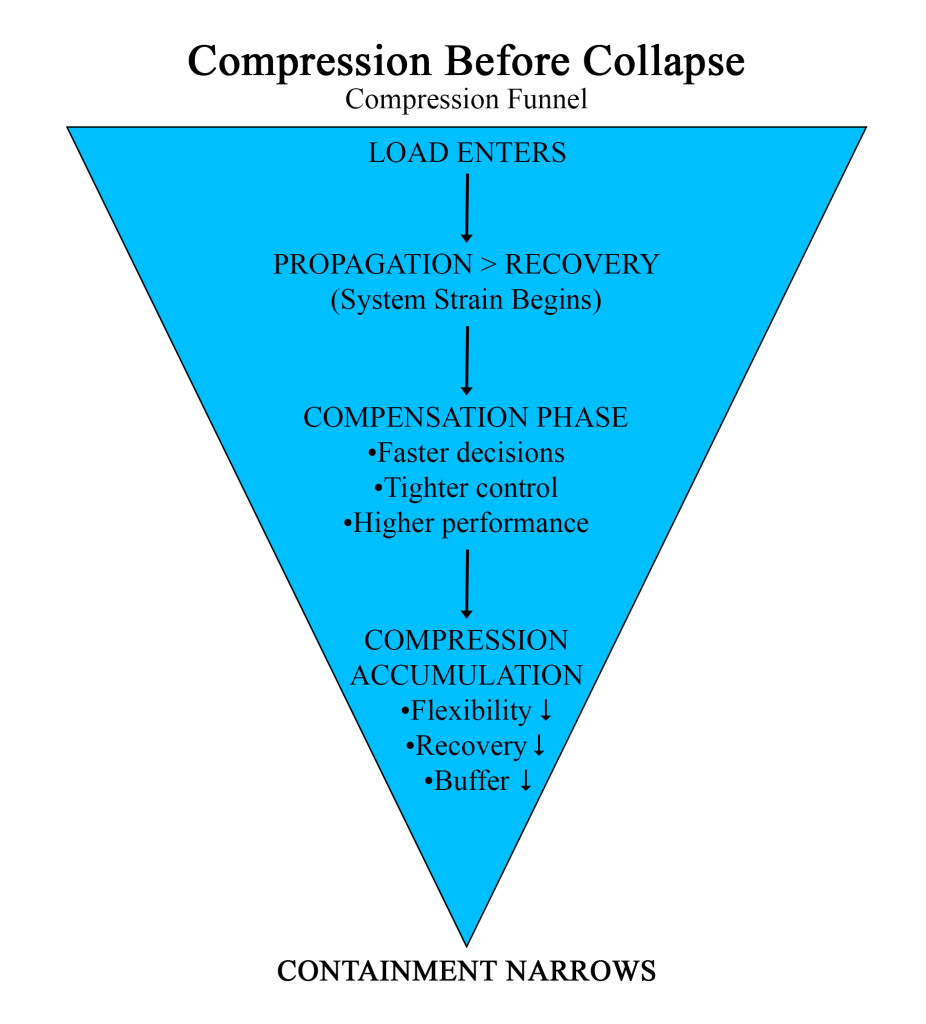
How Compression Forms
Compression begins when operational load enters faster than recovery clears.
Pressure propagates through routing pathways across the system.
If recovery matches propagation, stability holds.
When propagation exceeds recovery, residual strain remains.
That strain accumulates.
Accumulated strain narrows capacity.
This narrowing is compression.
Load enters
↓
Pressure propagates
↓
Recovery falls behind propagation
↓
Residual strain accumulates
↓
Compression forms
This sequence does not change.
Compression follows the same structural order every time.
Compensation Hides Compression
When load exceeds recovery capacity, the system adapts.
• Coordination tightens
• Decision speed accelerates
• Authority centralizes
• Oversight increases
These adaptations improve short-term performance.
From the outside, the system appears stable.
Internally, margin is shrinking.
Compensation protects movement.
It does not restore buffer.
Where Compression Forms
Compression does not appear everywhere equally.
It concentrates where pressure converges.
Common compression points include:
• decision points
• escalation pathways
• cross-system dependencies
• coordination hubs
• authority bottlenecks
These locations absorb pressure from multiple directions.
When pressure converges faster than recovery clears it, compression accumulates locally.
The cause is structural concentration
Compression Development
Compression develops gradually.
Early compression may appear as improvement.
Output rises.
Coordination improves.
Focus intensifies.
Mid compression narrows flexibility.
Delegation decreases.
Coordination density increases.
Recovery windows shrink.
Late compression produces visible instability.
Escalation frequency rises.
Time distortion intensifies.
Decision congestion appears.
By the time these signals appear, containment is already narrowing.
The Stability Illusion
Compression is difficult to detect because performance improves during early stages.
Centralized authority speeds decisions.
Tighter coordination reduces ambiguity.
These conditions resemble optimization.
Optimization increases output without narrowing capacity.
Compression increases output while narrowing capacity.
The difference becomes visible when recovery disappears.
Time Distortion
Under compression, time compresses.
Deadlines feel closer.
Interruptions carry more weight.
Transition time disappears.
Recovery windows shorten.
This is mechanical saturation.
When recovery falls behind propagation:
• tasks stack
• coordination tightens
• transition time disappears
• reflection shortens
• pause becomes inefficient
Time distortion indicates the system is operating near tolerance.
Time does not accelerate.
Buffer disappears.
Authority Centralization
As compression builds, authority converges.
Decision ownership narrows.
Escalation increases.
Oversight expands.
Centralization stabilizes short-term execution.
It also increases load density.
When authority compresses into a small number of connection points:
• decision fatigue rises
• escalation frequency increases
• routing complexity grows
• recovery shortens
• span exceeds sustainable range
Authority centralization stabilizes under pressure.
Sustained centralization amplifies strain.
Recovery Narrows
Recovery clears propagation and restores operational stability.
Under compression, recovery narrows first.
Reflection decreases.
Spacing between commitments compresses.
Coordination cadence accelerates.
Operational pauses disappear.
The system continues functioning.
Restoration does not fully occur.
When recovery narrows:
• residual strain accumulates
• flexibility decreases
• volatility risk rises
• escalation frequency increases
Recovery cannot be deferred indefinitely.
If it is, compression converts into threshold breach.
Strength and Strain
Performance may improve during compression.
Output increases.
Coordination strengthens.
Authority concentrates.
Strength and strain rise together.
Because delivery remains strong, compression appears manageable.
Internally, tolerance contracts.
When compression exceeds capacity, containment fails.
This failure is rupture.
STRUCTURAL OBSERVATION — COMPRESSION SIGNALS
Where is compression forming inside the system?
Observe:
• Where does urgency remain constant?
• Where has recovery time disappeared?
• Where do decisions stack without pause?
• Where does authority concentrate?
• Where does coordination density increase?
List the locations where pressure accumulates.
Chapter 2 — Rupture
The sequence below helps you remain oriented within the system progression presented in this book.
System Sequence
CHAPTER OVERVIEW
Rupture occurs when compression exceeds containment capacity and structural tolerance is breached.
COMPRESSION
↓
►RUPTURE
↓
CYCLE FORMATION
↓
RECONFIGURATION MODEL
↓
ARCHITECTURE MAPPING
↓
AUTHORITY REDISTRIBUTION
↓
REFLEX REWEIGHTING
↓
CONTAINMENT TESTING
↓
IRREVERSIBILITY
↓
SCALING
Each chapter builds on the previous structural layer.
About This Chapter
Rupture is a structural threshold breach.
Compression accumulates until containment fails.
The visible event reveals an existing structural limit.
Rupture exposes where the system can no longer stabilize.
Structural Conditions of Rupture
Rupture is threshold breach.
A system remains stable as long as recovery keeps pace with propagation.
Load enters through commitments, decisions, coordination demands, and environmental pressure.
Propagation spreads pressure through routing pathways, domains, and authority structures.
Recovery clears strain and restores operational margin.
As long as recovery keeps pace with propagation, containment holds.
Threshold breach occurs when three conditions converge:
Propagation > Recovery
Compression ≥ Capacity
Containment ≤ 0
When these conditions align, rupture occurs.
They occur in sequence.
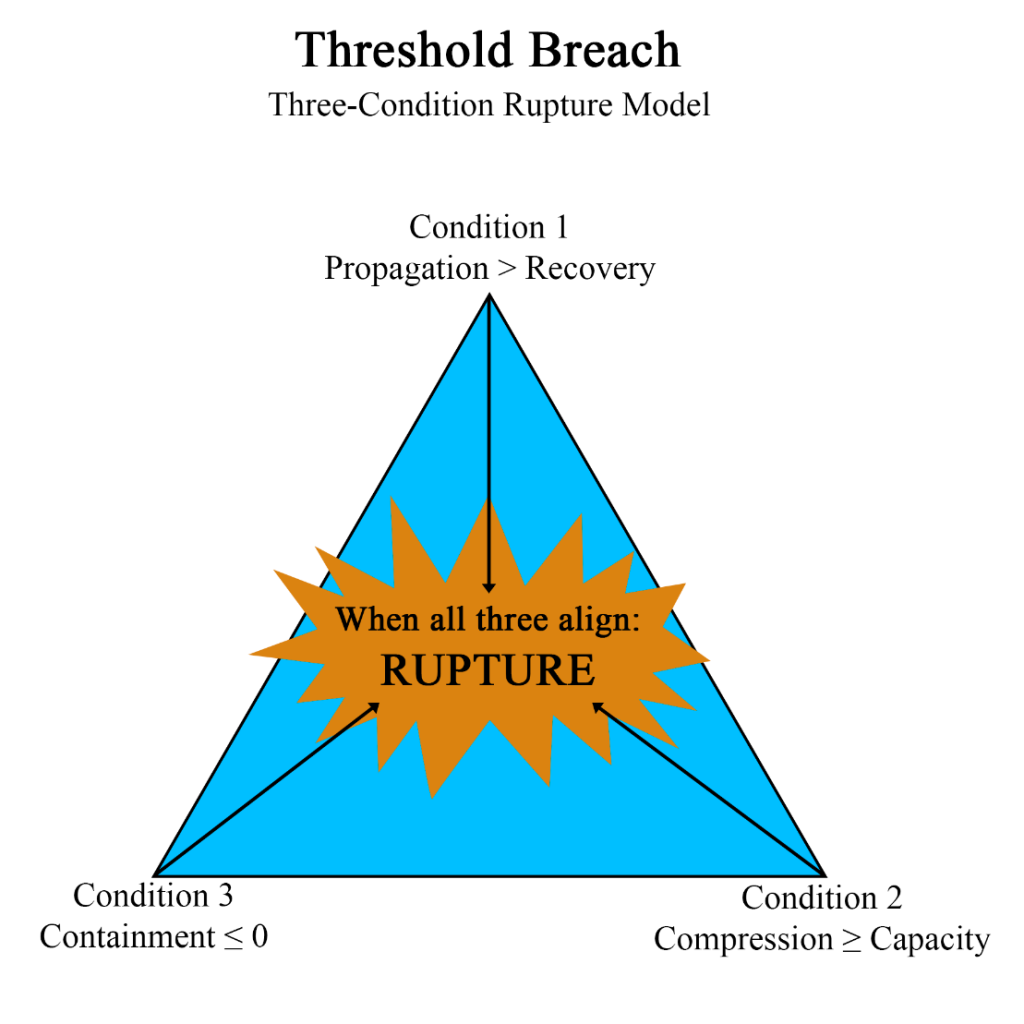
Rupture is not random. It is ordered.
The Moment of Rupture
Rupture is the moment when accumulated compression exceeds the system’s ability to stabilize.
The triggering event is often small:
• delayed decision
• missed dependency
• domain conflict
• authority conflict
These events do not create rupture.
They reveal it.
The underlying compression already exists.
To observers, the event appears sudden.
Structurally, rupture is the result of accumulated compression reaching zero containment.
Under sustained load without reconfiguration, this condition will occur.
Where Rupture Appears First
Rupture rarely appears everywhere at once.
It appears where pressure has already been concentrating.
Common rupture points include:
• decision bottlenecks
• cross-system dependencies
• coordination hubs
• authority points carrying excessive load
These locations absorb pressure from multiple pathways.
When routing converges through limited points, pressure density increases.
Compression accumulates at these points.
Rupture becomes visible where convergence exceeds structural tolerance.
The visible location is not the cause.
It is the first point where containment reached zero.
Propagation Is Greater Than Recovery
Propagation is the rate at which pressure spreads.
Recovery is the rate at which pressure clears.
When propagation exceeds recovery:
• residual strain accumulates
• buffer disappears
• escalation thresholds lower
• coordination density increases
• flexibility narrows
The system continues operating.
It no longer clears what it absorbs.
Compression Is Greater Than Capacity
Capacity defines how much compression a system can sustain.
When compression equals or exceeds capacity:
• authority congestion increases
• decision queues expand
• time distortion intensifies
• recovery collapses
The system operates at full tolerance.
No reserve margin remains.
Containment Less Than Sufficient
Containment is the ability to absorb pressure without fragmentation.
When containment reaches zero:
• stabilization fails
• coordination fragments
• escalation spikes
• domains withdraw
• decision flow collapses
This is rupture.
Compression is gradual.
Rupture is the visible breach.
Immediate Structural Effects of Rupture
Once containment fails:
• authority destabilizes
• escalation increases
• decision flow disrupts
• coordination fragments
• recovery collapses
The system attempts stabilization through reactive adjustments:
• emergency authority concentration
• conflict escalation
• defensive domain behavior
• abrupt operational pauses
These responses reduce pressure temporarily.
They do not change structure.
Why Rupture Appears Sudden
Compression develops gradually while performance remains strong.
Coordination improves.
Authority clarifies.
Delivery accelerates.
These signals resemble optimization.
Compression narrows stabilization bandwidth at the same time.
Because output remains high, warning signals are ignored.
When containment fails, the visible event appears abrupt.
Rupture is not sudden.
Compression accumulated before the breach.
STRUCTURAL OBSERVATION — RUPTURE EVENT
Identify a rupture event inside the system.
Observe:
• Where had propagation exceeded recovery?
• Where had compression accumulated?
• Where had containment narrowed?
• Where had authority centralized beyond span?
• Where had coordination density intensified?
List the structural conditions present before rupture.
Chapter 3 — Cycle Formation
TSystem Sequence
COMPRESSION
↓
RUPTURE
↓
►CYCLE FORMATION
↓
RECONFIGURATION MODEL
↓
ARCHITECTURE MAPPING
↓
AUTHORITY REDISTRIBUTION
↓
REFLEX REWEIGHTING
↓
CONTAINMENT TESTING
↓
IRREVERSIBILITY
↓
SCALING
Each chapter builds on the previous structural layer.
About This Chapter
Rupture interrupts compression but does not change structure.
If architecture remains unchanged, compression rebuilds along the same pathways.
Cycles repeat under the same structural conditions.
Relief reduces pressure temporarily.
Reconfiguration changes structure and expands containment.
Rupture Does Not Produce Change
Rupture interrupts pressure.
Recovery increases temporarily.
Structural capacity remains unchanged.
Rupture does not alter the structure that produced compression.
If architecture remains unchanged, the system returns to the same structural conditions.
This is cycle formation.
Without architectural change, the following remain unchanged:
• span
• routing
• escalation reflex
• exposure
• compression threshold
Why Cycles Repeat
When these variables remain unchanged, pressure accumulates along the same pathways.
Load enters.
Propagation accelerates.
Recovery narrows.
Compression forms.
Compression follows the same pathways and reaches the same limits.
The system repeats:
compression → rupture → relief → compression
The same sequence repeats because structure has not changed.
Same Span
Span defines responsibility, coordination density, and decision load.
If span remains unchanged:
• authority reconcentrates
• decision density rebuilds
• coordination load increases
• recovery compresses
Capacity has not expanded.
Same Routing
Routing defines how pressure moves.
If routing remains unchanged:
• congestion returns
• escalation bottlenecks reappear
• delegation narrows
• compensation rebuilds
Pressure follows the same pathways.
The same pathways overload again.
Same Escalation Reflex
Escalation reflex determines response under pressure.
If unchanged:
• authority centralizes
• control intensifies
• communication compresses
• flexibility narrows
The same stabilization response reactivates.
Same Exposure
Exposure defines how much load the system accepts.
If unchanged:
• propagation rate returns
• coordination accelerates
• recovery shortens
• buffer disappears
No structural expansion has occurred.
Same Compression Threshold
Every structure has a compression threshold.
If unchanged:
• the same workload triggers compression
• the same cadence accelerates strain
• the same dependencies breach containment
The trigger may differ.
The threshold does not.
Cycle Acceleration
When structure remains unchanged, cycles accelerate.
Recovery shortens.
Operational cadence increases.
Coordination density rises.
Compression rebuilds faster after each rupture.
Time between rupture events decreases.
The structure has not changed.
The load has increased.
Cycle Entrenchment
Repeated cycles normalize instability.
Compression becomes expected.
Authority centralization becomes routine.
Escalation density increases.
The system adapts to recurring rupture.
Compression → rupture → relief becomes the operating rhythm.
The system is not recovering.
It is repeating.
Relief Pattern

After rupture, systems produce relief:
• operations pause
• commitments reduce
• coordination resets
• authority stabilizes
Relief reduces pressure temporarily.
Structure remains unchanged.
The next cycle forms.
Relief vs Reconfiguration
Relief reduces pressure.
Reconfiguration changes structure.
Relief restores stability temporarily.
Reconfiguration expands containment.
Relief feels like change.
Reconfiguration holds under load.
Cycles repeat when relief is mistaken for structural change.
Rupture interrupts motion.
Only structural redesign prevents repetition.
Why Relief Feels Like Change
Relief reduces pressure.
Recovery increases temporarily.
Coordination improves.
Authority stabilizes.
These conditions resemble progress.
But load has been reduced.
Structure has not changed.
As pressure returns, the same limits reappear.
Relief removes pressure.
Reconfiguration expands containment.
STRUCTURAL OBSERVATION — FALSE RECOVERY CHECK
After rupture, identify what remained unchanged:
• span
• routing
• escalation reflex
• exposure
• compression threshold
Which returned exactly as before?
Structural cycles continue until architecture changes.
Chapter 4 — Reconfiguration Model
System Sequence
COMPRESSION
↓
RUPTURE
↓
CYCLE FORMATION
↓
► RECONFIGURATION MODEL
↓
ARCHITECTURE MAPPING
↓
AUTHORITY REDISTRIBUTION
↓
REFLEX REWEIGHTING
↓
CONTAINMENT TESTING
↓
IRREVERSIBILITY
↓
SCALING
About This Chapter
Containment expands through structural reconfiguration.
Stages reflect how systems reorganize under increasing load.
Expansion occurs through changes in authority, routing, and recovery.
Stabilization shifts as containment increases.
1. FOUNDATION — CONTAINMENT & STAGES
Stage Mechanics Overview
• Systems expand their ability to carry pressure over time by changing structure
• As load increases, structure must adapt so work, decisions, and coordination move without creating compression
Containment
• Containment describes how effectively a system processes pressure
Containment has three structural components:
• Containment architecture
the structural design
• Containment capacity
the maximum pressure the structure can absorb
• Containment bandwidth
the rate at which pressure can move through the system without creating compression
Stages
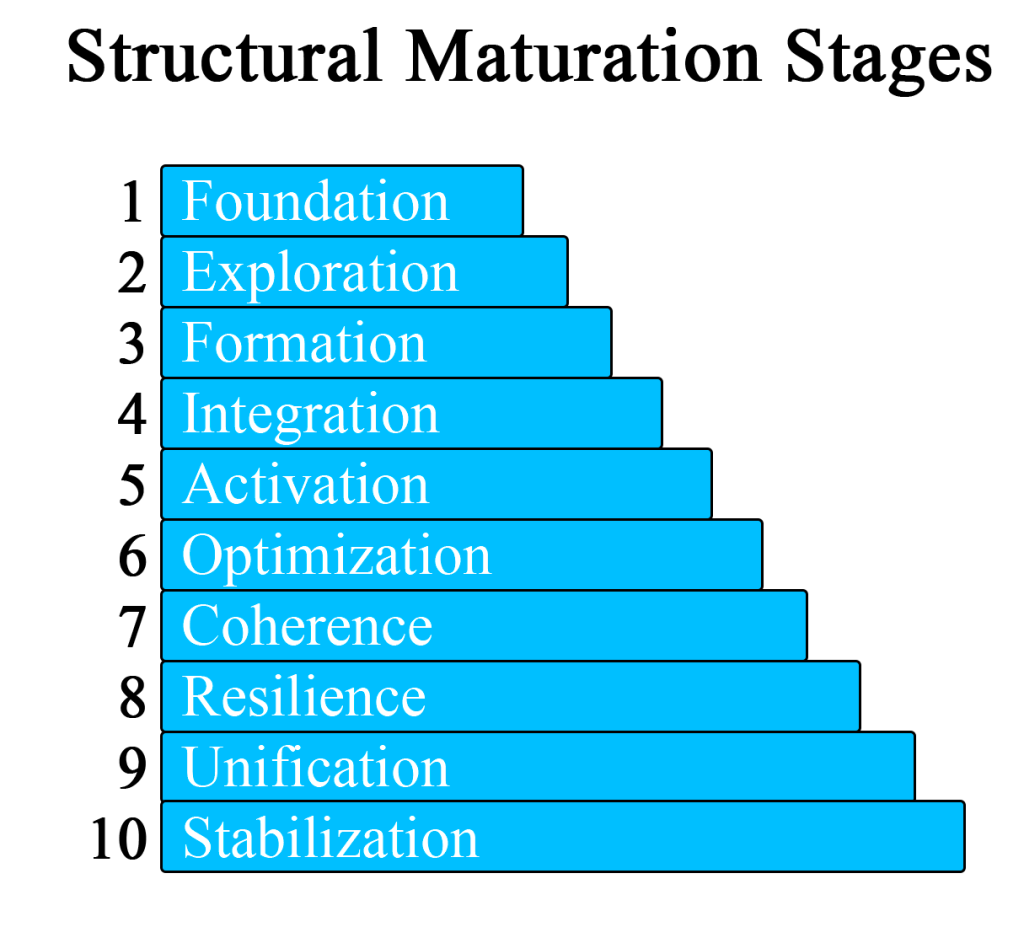
• Containment expands through ten stages of structural development
• authority distributes across decision points
• routing pathways develop across the system
• operational load spreads across roles and domains
• the system’s ability to carry pressure increases
Stages are not based on time, tenure, or experience.
They reflect structural capability under load.
Structural Terms Used in the Stage Model
Phase
Defines the dominant structural work at each stage
Expanding, stabilizing, or integrating capacity
Phase labels:
• Foundation
• Exploration
• Formation
• Integration
• Activation
• Optimization
• Coherence
• Resilience
• Unification
• Stabilization
Stage
A specific containment configuration
Defines:
• authority distribution
• routing behavior
• pressure flow
Stages describe structure — not status.
STAGE RESOLUTION
Stages define containment configuration under load.
They do not represent a single fixed position.
Each stage contains variation in how containment operates.
Containment does not expand in discrete jumps.
It expands through accumulated structural change.
Within a stage:
• containment may be forming
• containment may be stabilizing
• containment may be consolidating
• containment may be approaching its next threshold
These conditions reflect how containment develops within the stage.
Development occurs through repeated rupture–reconfiguration cycles.
Each cycle produces structural adjustment.
These adjustments accumulate.
Accumulation increases the system’s ability to carry pressure without compression.
Stage classification identifies the containment configuration.
It does not fully describe the degree of development within that configuration.
A system may be early in a stage.
It may be stable within a stage.
It may be approaching transition.
All are structurally different conditions within the same stage.
Transition does not occur because time has passed.
It does not occur because awareness increases.
It occurs when accumulated structural change expands containment beyond its previous threshold.
Until that threshold is exceeded, the system remains within the same stage.
Even if multiple rupture events occur.
Even if performance improves.
Even if pressure temporarily decreases.
Rupture does not advance stages.
Relief does not advance stages.
Accumulated structural change advances stages.
MICRO–MACRO RELATIONSHIP OF DEVELOPMENT
Rupture and development operate at different structural scales.
Rupture occurs at the event level.
Development occurs at the accumulation level.
At the event level:
• load enters
• pressure propagates
• recovery falls behind
• compression accumulates
• rupture occurs
Rupture reorganizes structure locally.
It does not guarantee expansion.
At the developmental level:
• structural adjustments accumulate
• routing changes stabilize
• authority redistributes
• recovery improves relative to propagation
• containment expands
Development reflects the accumulation of these changes across time.
Multiple rupture events may occur without development.
Development occurs only when structural change holds under load.
When structural adjustments do not hold:
• routing returns
• authority reconcentrates
• recovery narrows
• compression rebuilds
The system remains in the same stage.
When structural adjustments hold:
• pressure distributes more effectively
• recovery clears propagation more consistently
• routing expands across the structure
• containment increases
When this accumulation exceeds the previous structural limit:
Stage transition occurs.
DEVELOPMENT IS ACCUMULATION
Stages do not move.
Systems move within stages.
Movement becomes visible as stage progression only after sufficient structural change has accumulated.
Small changes that do not hold do not accumulate.
Changes that do not accumulate do not expand containment.
Without accumulation:
• cycles repeat
• compression rebuilds
• rupture reoccurs
With accumulation:
• containment expands
• routing distributes
• recovery stabilizes
• compression thresholds increase
This is development.
LOCKED PRINCIPLE
Stages are not advanced through events.
They are not advanced through insight.
They are not advanced through temporary stability.
They are advanced through accumulated structural change that holds under load.
2. MOVEMENT — SPRINT AND REGULATE
Systems move through stages by alternating between two operating conditions.
Sprint phases expand span, exposure, and coordination.
Regulate phases stabilize routing and redistribute pressure.
Systems alternate between expansion and stabilization as pressure moves through the structure.
Maturation does not progress linearly.

Sprint Mode
• expansion of span
• increase in exposure
• authority assertion
• connection growth across the system
Sprint phases increase propagation and introduce new pressure.
Regulate Mode
• routing stabilization
• authority redistribution
• buffer restoration
• load diffusion across the system
Regulate phases restore containment after expansion.
Without regulation, sprint creates compression.
Without expansion, regulation produces stagnation.
Maturation requires alternation between expansion and stabilization.
Each cycle follows the same sequence:
rupture → reconfiguration → containment expansion
Structural expansion occurs only when the sequence is reorganized.
Stage progression reflects accumulated structural change.
Stage transitions occur when load exceeds containment capacity and structure reorganizes to absorb it.
These shifts follow stabilization patterns defined by the CORE model.
3. CORE MODEL — STABILIZATION STRUCTURE
Systems stabilize pressure through four structural orientations.
The CORE model identifies:
• Commander — directional authority
• Opener — relational alignment
• Regulator — operational continuity
• Engineer — structural construction

Each vector organizes pressure and maintains stability under load.
Commander establishes direction and concentrates authority.
Opener distributes pressure across relational pathways.
Regulator stabilizes rhythm and continuity.
Engineer constructs and maintains structural pathways.
All systems rely on these functions:
Direction initiates movement.
Alignment maintains cohesion.
Regulation stabilizes flow.
Structure carries load.
CORE vectors define structural function, not behavior.
They determine how authority distributes, how pressure routes, and how stability restores under strain.
Each stage stabilizes through a defined CORE pairing.
These pairings govern authority distribution and routing behavior.
As containment expands, stabilization distributes across more pathways.
At Stage 10, stabilization distributes across all CORE vectors.
CORE Pattern
Each stage reflects a containment configuration under load.
CORE pairings determine how pressure stabilizes at that stage.
System Stage Model
Containment configurations differ across stages under increasing load.
These differences are governed by stabilization patterns.
Phase | Stage | Active CORE Pattern | Structural Function | Mode |
Foundation | Stage 1 | Commander + Opener | Expand Connection | Sprint |
Exploration | Stage 2 | Opener + Regulator | Relational Smoothing | Regulate |
Formation | Stage 3 | Regulator + Engineer | Establish Structure | Regulate |
Integration | Stage 4 | Engineer + Commander | Containment Construction | Sprint |
Activation | Stage 5 | Commander + Opener | Coordinate Expansion | Sprint |
Optimization | Stage 6 | Opener + Regulator | External Interaction Stability | Regulate |
Coherence | Stage 7 | Regulator + Engineer | Stabilize Load | Regulate |
Resilience | Stage 8 | Engineer + Commander | Optimize Routing | Sprint |
Unification | Stage 9 | Commander + Opener | Systemic Reconciliation | Sprint |
Stabilization | Stage 10 | Balanced CORE | Equilibrium | Equilibrium |
4. SPIRAL DEVELOPMENT — CONTAINMENT EXPANSION
Stage progression follows a spiral expansion of containment across the CORE axis.
Balanced equilibrium becomes possible only after containment expands across the full structure.
This progression reflects recurring stabilization patterns under increasing load
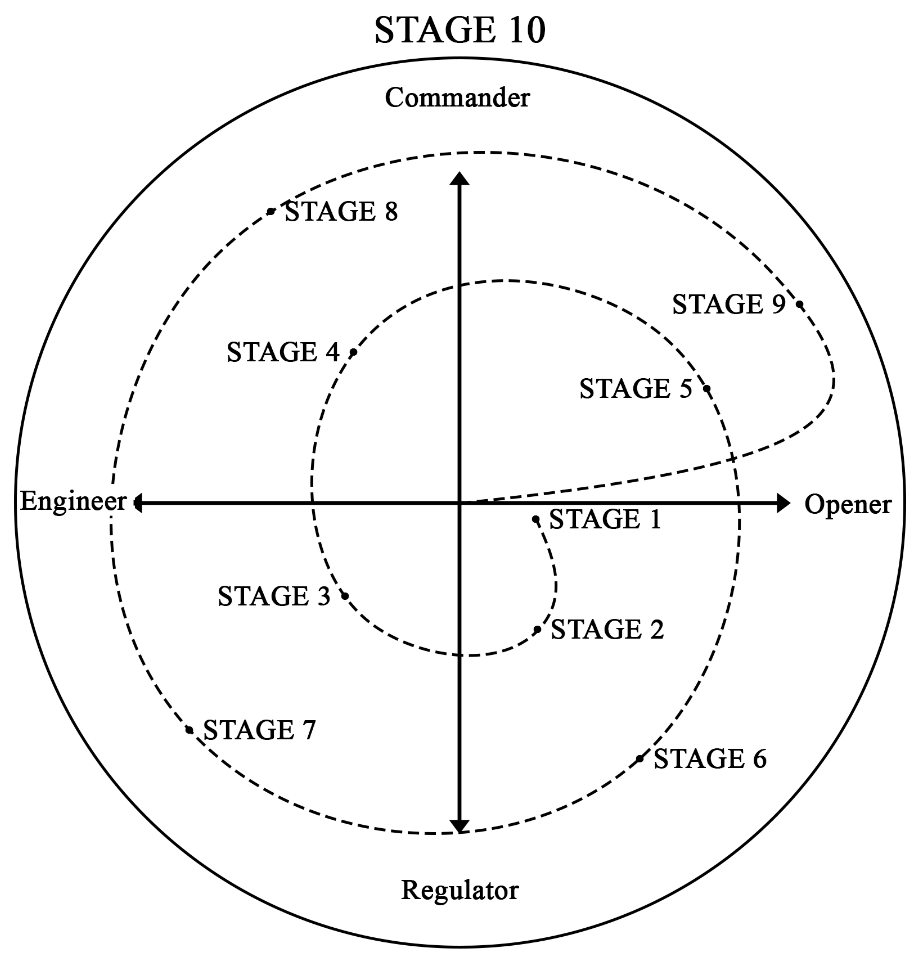
As containment expands, systems revisit the same CORE orientations to reorganize authority distribution, routing pathways, and coordination under increasing pressure.
Structural Symmetry of CORE Progression
CORE patterns repeat across stages.
This repetition reflects expansion under increasing load, not duplication.
The same orientations reappear at higher capacity levels.
Stage progression follows a repeating sequence:
1 — Commander + Opener
2 — Opener + Regulator
3 — Regulator + Engineer
4 — Engineer + Commander
5 — Commander + Opener
6 — Opener + Regulator
7 — Regulator + Engineer
8 — Engineer + Commander
9 — Commander + Opener
This pattern is not circular.
It is spiral expansion under increasing load.
Each pass occurs under greater load and wider span than the previous cycle.
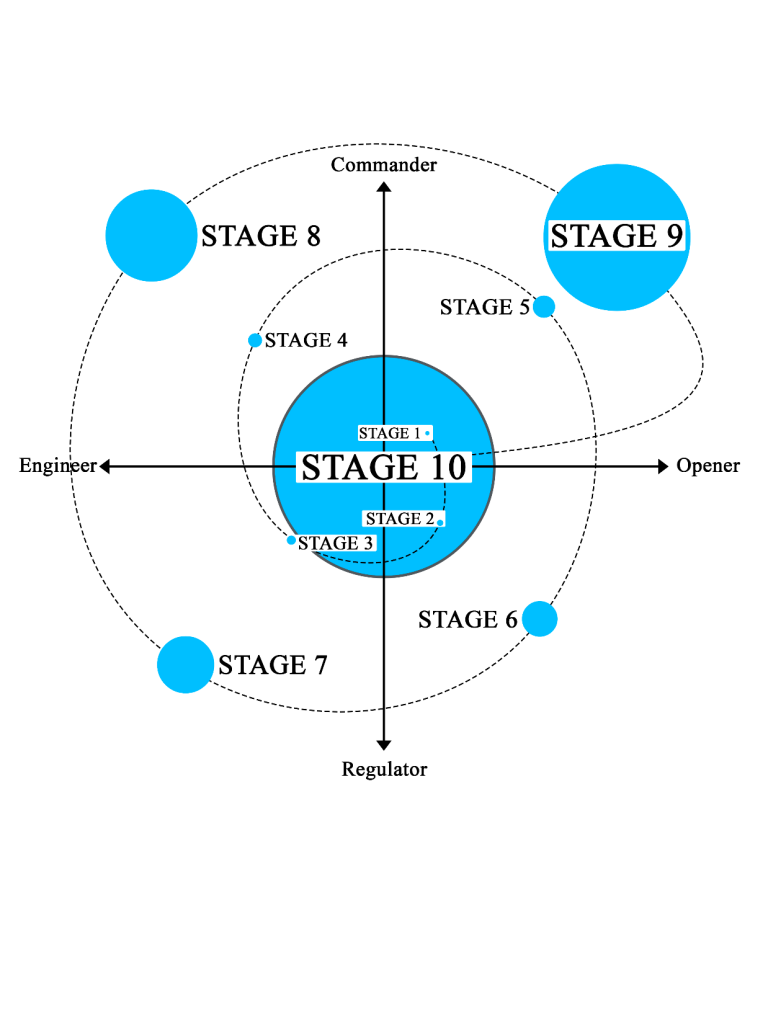
Cycle Structure of Containment Expansion
Containment develops through three structural cycles:
Cycle 1 — Containment Formation
Establishes initial containment structure.
1 — Foundation
2 — Exploration
3 — Formation
4 — Integration
This cycle produces the first stable containment configuration.
Cycle 2 — Containment Expansion
Expands capacity to absorb greater load.
5 — Activation
6 — Optimization
7 — Coherence
8 — Resilience
This cycle increases capacity and operational bandwidth.
Cycle 3 — Containment Integration
Integrates containment across the system.
9 — Unification
10 — Stabilization
Authority, routing, and recovery distribute across the structure.
Development Pattern
System maturation follows three movements:
• build containment
• expand containment
• integrate containment
Each cycle increases the system’s ability to absorb propagation without collapse.
Balanced CORE stabilization emerges only after containment matures across the full spiral.
Balance is not the starting condition.
It emerges when containment supports distributed stabilization.
Structural Transition
Transitions describe reorganization between stages.
They are not stages.
Examples include:
• reduction
• rebinding
• assertion
• distribution
• bandwidth expansion
These transitions occur as load, propagation, and recovery reorganize the structure.
MICRO–MACRO ALIGNMENT — RUPTURE AND DEVELOPMENT
Rupture and development operate at different scales.
Rupture occurs at the event scale.
Stage progression occurs at the developmental scale.
At the event scale:
load enters
pressure propagates
compression forms when propagation exceeds recovery
containment narrows to threshold breach
rupture occurs
Rupture reorganizes structure locally.
Stage progression reflects accumulated structural change across events.
Multiple rupture events may occur within the same stage if containment does not expand.
Stage transition occurs only when containment exceeds previous limits.
Rupture does not produce development.
Structural expansion produces development.
Rupture Dynamics
Rupture occurs in both sprint and regulate conditions.
During regulate phases, rupture reveals accumulated compression.
During sprint phases, rupture occurs under expanded load and produces larger structural shifts.
Structural expansion determines whether those shifts hold.
Rupture exposes structural failure.
Reconfiguration redesigns structure.
This section examines how authority redistributes, routing changes, and escalation reflex shifts after collapse.
Growth does not occur through relief.
It occurs through structural redesign.
Chapter 5 — Architecture Mapping
System Sequence
CHAPTER OVERVIEW
Architecture mapping defines how pressure routes through structure and where authority, escalation, and load concentrate.
COMPRESSION
↓
RUPTURE
↓
CYCLE FORMATION
↓
RECONFIGURATION MODEL
↓
► ARCHITECTURE MAPPING
↓
AUTHORITY REDISTRIBUTION
↓
REFLEX REWEIGHTING
↓
CONTAINMENT TESTING
↓
IRREVERSIBILITY
↓
SCALING
About This Chapter
Architecture mapping exposes how pressure routes through structure.
Rupture creates visibility but does not produce it.
Visibility occurs when routing, authority, and recovery are examined structurally.
Concentration forms where pressure does not clear.
Mapping reveals where redistribution is required.
Architecture mapping reveals structure after rupture.
It traces where pressure routed when containment failed.
It does not evaluate current stability.
Diagnosis evaluates where structure does not hold under current conditions.
Recovery Collapse
Recovery erodes incrementally.
Transition time shortens.
Operational pauses disappear.
Coordination overlaps increase.
Meetings multiply.
Cadence stacking produces:
• interruptions layer
• decisions stack
• coordination overlaps
• reflection disappears
Recovery is not removed.
It fails to occur.
Exposure Miscalculation
Exposure increases without containment expansion.
Admission rate rises through:
• new commitments
• additional projects
• expanded partnerships
• increased coordination density
Exposure grows faster than buffer.
The system is not overwhelmed by intensity.
It is overwhelmed by volume.
Misplaced Span
Authority span widens gradually.
Responsibilities accumulate across:
• operational direction
• relational stabilization
• conflict arbitration
• schedule enforcement
• contingency management
• cross-system coordination
Span expands.
Authority does not redistribute.
Tolerance is exceeded through accumulated responsibility density.
Structural Observation
These are structural conditions.
They are not behavioral.
They are not cultural.
Structural observation identifies:
• where decisions converge
• where authority centralizes
• where escalation concentrates
• where recovery disappears
• where load accumulates
The question shifts:
From: What went wrong?
To: Where does pressure route?
Structural Visibility
Rupture interrupts motion.
Visibility occurs when routing, authority, and recovery are examined structurally.
Mapping reveals where pressure concentrates and where it fails to clear.
Structural Reorganization Sequence
Once routing is visible, redesign becomes possible.
Without visibility, cycles repeat.
With visibility, structure can change.
Structural Transition Sequence
Contraction / Reorganization
1 — Structural Reduction
• authority concentrates
• routing narrows
• pressure converges
2 — Rebinding
• new routing forms
• pressure distributes
• recovery clears more evenly
Expansion
3 — Directed Assertion
• authority extends along defined pathways
• operational reach expands
4 — Identity Stabilization
• routing stabilizes
• recovery clears consistently
Distribution / Stabilization
5 — Distributed Regulation
• authority distributes
• load spreads
• recovery stabilizes
6 — Expanded Bandwidth
• higher load is absorbed
• escalation reduces
• containment becomes flexible
Interaction Stability
7 — External Coherence
• external pressure does not distort internal routing
8 — Sovereign Containment
• containment holds under external instability
System Integration
9 — Systemic Reconciliation
• instability resolves across the system
10 — Stage Stabilization
• pressure clears without rupture
• containment holds under expected load
Stage 10 Structural Boundary
Stage 10 represents distributed containment.
Authority, routing, and recovery operate across the system.
Compression alone does not produce regression.
Regression occurs only when structure changes.
Structural Principle
Stage progression reflects repeated containment cycles.
Reconfiguration expands the system’s ability to absorb propagation without collapse.
Structural Development Sequence
Directional stabilization
↓
Containment formation
↓
Containment expansion
↓
Containment integration
↓
Balanced system operation
Balance is not the method.
It is the result.
THOS Principle
THOS does not regulate behavior.
It redesigns structure.
When routing and containment change, behavior follows.
Structural Visibility Under Rupture
Rupture interrupts motion.
Compression becomes visible.
Deadlines tighten.
Coordination intensifies.
Decisions accelerate.
Escalations increase.
These signals reflect pressure.
After rupture, the system traces routing.
Authority convergence becomes visible.
Escalation pathways become visible.
Routing concentration becomes visible.
Compression is structural concentration.
Escalation Reflex
Under load, escalation moves toward centralization:
• decisions accelerate
• responsibility concentrates
• control tightens
This stabilizes short-term execution.
It increases compression over time.
Centralization increases propagation density.
Propagation exceeds recovery.
STRUCTURAL OBSERVATION — ARCHITECTURE VISIBILITY
Map system routing.
Where do the following converge?
• decisions
• escalation
• coordination
• conflict resolution
• responsibility
Which point carries the highest pressure density?
Where does escalation route under load?
Mapping reveals where pressure concentrates.
Authority redistribution determines whether pressure distributes or converges.
Chapter 6 — Authority Redistribution
System Sequence
CHAPTER OVERVIEW
Authority redistribution relocates decisions, recalibrates escalation, and distributes load across structure to expand containment.
COMPRESSION
↓
RUPTURE
↓
CYCLE FORMATION
↓
RECONFIGURATION MODEL
↓
ARCHITECTURE MAPPING
↓
►AUTHORITY REDISTRIBUTION
↓
REFLEX REWEIGHTING
↓
CONTAINMENT TESTING
↓
IRREVERSIBILITY
↓
SCALING
ABOUT THIS CHAPTER
Authority redistribution shifts where decisions occur and how escalation routes.
Rupture exposes where authority has converged.
Without redistribution, pressure continues through the same connections and compression rebuilds.
Redistribution distributes load across structure, stabilizes span, and reduces escalation density.
Authority Concentration and Structural Correction
Rupture exposes where authority concentrated.
Reconfiguration begins when authority moves.
Compression formed because load converged.
Decisions defaulted upward.
Escalations routed to a small number of decision points.
Recovery narrowed as span widened without redistribution.
If authority remains centralized after rupture, the next compression cycle is guaranteed.
Authority redistribution is not surrender.
It is structural correction.
Authority Redistribution Model
Compression forms when three conditions align:
Authority convergence
Escalation density
Span overload
Redistribution corrects these conditions through three structural shifts:
• authority distribution
• escalation filtering
• span stabilization
Decision Rights Reassignment
Before rupture, minor issues escalated quickly.
Routine decisions defaulted upward.
Coordination flowed through central decision points.
Efficiency increased compression over time.
Reassignment relocates decisions to their natural proximity:
• operational issues resolve within systems
• domain experts answer technical questions
• scheduling decisions occur locally
• ownership clarity prevents automatic escalation
This reduces load density at the congestion point.
Authority relocates.
Escalation Threshold Recalibration
Escalation thresholds determine when pressure rises through the system.
Before rupture, thresholds drifted downward.
Minor disturbances activated authority attention.
Reaction speed accelerated.
Urgency became default.
Recalibration raises thresholds intentionally:
• not every issue activates authority oversight
• delay is tolerated when operationally safe
• urgency is filtered before escalation
• local resolution precedes upward routing
Escalation density decreases.
When thresholds align, propagation slows without suppressing responsibility.
Span Narrowing Before Expansion
After rupture, expansion increases compression risk.
Span narrows before expansion.
This requires:
• removing redundant commitments
• sequencing overlapping responsibilities
• separating high-volatility operational roles
• reducing simultaneous decision stacking
Span reduction restores containment margin.
Narrowing span is not regression.
It is containment stabilization.
Routing Redesign
Routing determines where pressure travels.
Previously, pressure moved directly to centralized decision points.
That routing increased compression.
Redesign introduces separation:
• defined domains for operational decisions
• structured coordination channels
• clear authority boundaries
• visible ownership mapping
Load no longer converges automatically.
Pressure distributes across the system.
Recovery increases relative to propagation.
Buffer Protection
Recovery was previously assumed.
It becomes structural.
Buffer protection includes:
• preserved transition intervals
• protected recovery windows
• reduced overlap between high-load domains
• deliberate operational pauses
Recovery becomes equal to or greater than propagation.
Without protected buffer, redistribution fails.
Admission Discipline
Before rupture, admission expanded without constraint.
Commitments increased faster than containment capacity.
Admission becomes structural:
• new commitments are evaluated before acceptance
• load propagation is modeled across systems
• coordination density is measured
• buffer expansion precedes exposure increase
Exposure becomes governed.
Reflex Interruption
Under destabilizing load, escalation reflex moves toward centralization.
Authority intensifies.
Control narrows.
Routing converges.
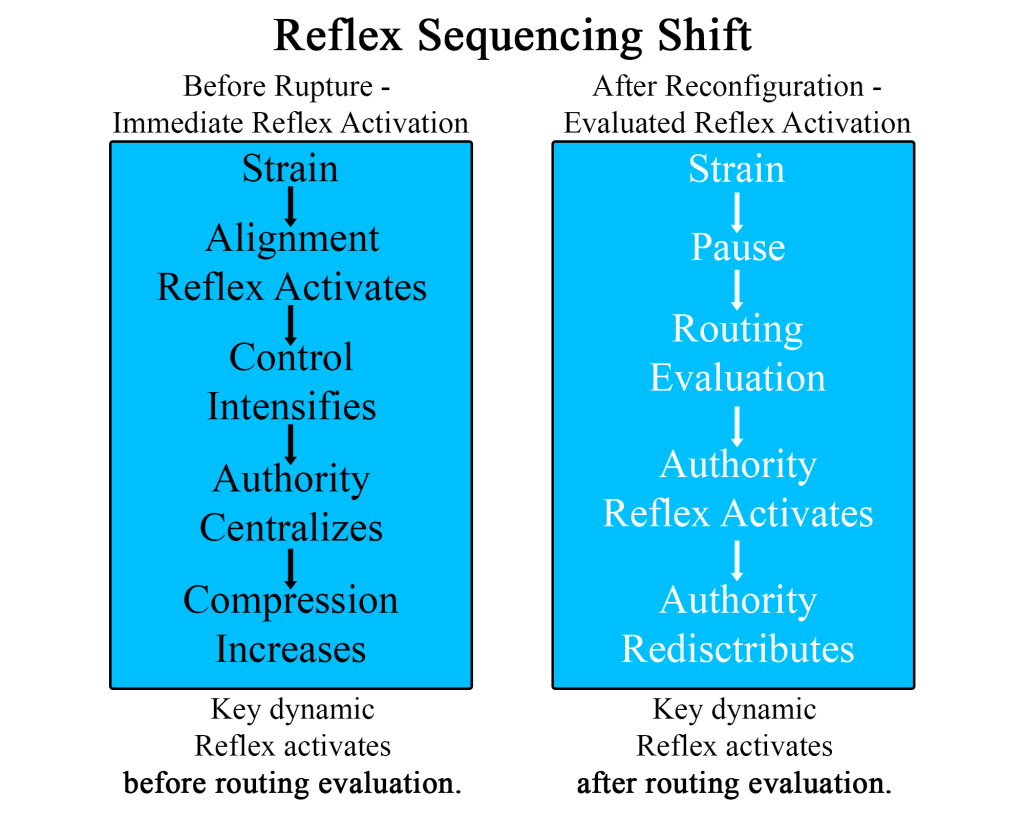
Reflex sequencing changes:
Pause precedes consolidation.
Evaluation precedes escalation.
Authority stabilizes without immediate convergence.
Pressure distributes before centralization occurs.
Identity remains stable under ordinary strain.
It changes only when structural reconfiguration stabilizes under load
Reflex sequencing under strain changes.
This marks structural maturation.
The Geometry Shift
Before redistribution:
• authority centralized
• escalation frequent
• span wide
• buffer thin
• recovery shorter than propagation
After redistribution:
• authority distributed
• escalation filtered
• span defined
• buffer protected
• recovery equal to or greater than propagation
Geometry Changes
This is structural redesign.
Authority redistribution is the first visible evidence of reconfiguration.
Without it, rupture repeats.
With it, containment expands.
STRUCTURAL OBSERVATION — REDISTRIBUTION MAP
Which decisions currently escalate?
Which could resolve locally?
List:
• decisions that require escalation
• decisions that could redistribute
• decisions that should not escalate
Which authority point carries the highest decision density?
This identifies where redistribution must begin.
Chapter 7 — Reflex Rewiring
System Sequence
CHAPTER OVERVIEW
Reflex reweighting changes activation under pressure to delay consolidation, evaluate routing, and distribute authority to preserve recovery.
COMPRESSION
↓
RUPTURE
↓
CYCLE FORMATION
↓
RECONFIGURATION MODEL
↓
ARCHITECTURE MAPPING
↓
AUTHORITY REDISTRIBUTION
↓
►REFLEX REWEIGHTING
↓
CONTAINMENT TESTING
↓
IRREVERSIBILITY
↓
SCALING
About This Chapter
Reflex describes how routing and authority shift under pressure.
Reflex reweighting is not behavioral.
It is structural routing under load.
Reflex Reweighting and Activation Shift
Authority redistribution changes routing.
Reflex reweighting changes activation.
Identity does not rotate or change casually.
It changes only when structural reconfiguration stabilizes under load.
Reflex activation changes under destabilizing load.
Stage progression does not introduce a new identity.
It expands containment across the same structure.
What appears as change is the system stabilizing pressure differently, not becoming something else.
Structure remains intact.
The order of stabilization changes under strain.
Stages describe structural dominance across the CORE axis.
Reflex sequencing describes how stabilization activates under pressure.
Reflex reweighting governs activation under destabilizing load.
Post-Reconfiguration — Reflex Sequence
Strain
↓
Pause
↓
Routing Evaluation
↓
Escalation Reflex Activates
↓
Authority Distributes
Reflex activation follows structural evaluation.
Reflex Sequencing Shift
Identity remains stable under ordinary strain.
It changes only when reconfiguration alters structure and holds under load.
Activation timing shifts under destabilizing load.
System Architecture vs Reflex Activation
Every system stabilizes through a dominant structural orientation.
This governs authority distribution, routing pathways, and coordination rhythm.
This architecture does not rotate under strain.
The system remains structurally anchored.
What changes is reflex activation under pressure.
Before reconfiguration:
Strain appears.
Response accelerates.
Authority centralizes.
Coordination narrows.
This sequence stabilizes short-term execution.
It increases compression.
Centralization increases propagation density.
Propagation exceeds recovery.
Reflex Reweighting
After redistribution, the activation sequence changes:
Pause → routing evaluation → authority distribution → stabilization
Under destabilizing conditions:
• authority does not immediately centralize
• routing evaluates before escalation
• responsibility distributes outward
• coordination stabilizes after distribution
Identity remains intact.
Activation sequence changes under strain.
What Reweighting Changes
Previously:
Strain → immediate consolidation → centralized authority
Now:
Strain → pause → evaluation → distributed stabilization
The stabilizing priority shifts from absorption to redistribution.
Reweighting changes:
• escalation speed
• authority consolidation timing
• load absorption order
• recovery preservation
Reweighting does not change:
• identity architecture
• structural orientation
• baseline authority structure
Why This Matters
If identity rotated under strain, structure would fragment.
Instead, architecture remains stable while activation regulates.
Before reconfiguration:
Compression triggered automatic centralization.
After reconfiguration:
Compression triggers evaluation before consolidation.
The difference is activation timing.
Delayed activation:
• protects buffer
• preserves recovery
• slows propagation
• reduces escalation density
Containment expands as activation slows under strain.
Structural Maturation
Maturation is not behavioral.
It is not cultural.
It is structural reweighting that holds under load.
When similar conditions occur and prior reflexes do not reactivate:
• identity remains stable
• activation sequence holds
• containment expands
This is structural maturation.
Transition
Structure has been redesigned.
Activation has been reweighted.
The system must now be tested under load.
Part III – Permanent Containment Expansion
Rupture revealed the structural failure.
Redistribution changed system geometry.
The question becomes measurable:
Does the structure now absorb pressure that previously produced rupture?
Structural change must hold under renewed load.
This section defines how containment expansion is tested.
Chapter 8 — Containment Testing
System Sequence
CHAPTER OVERVIEW
Containment testing applies load to confirm that escalation, recovery, authority, and buffer stability hold without recreating compression.
COMPRESSION
↓
RUPTURE
↓
CYCLE FORMATION
↓
RECONFIGURATION MODEL
↓
ARCHITECTURE MAPPING
↓
AUTHORITY REDISTRIBUTION
↓
REFLEX REWEIGHTING
↓
► CONTAINMENT TESTING
↓
IRREVERSIBILITY
↓
SCALING
About This Chapter
Containment testing applies load to observe whether stability holds.
Reconfiguration is confirmed under pressure, not intention.
If prior conditions do not recreate compression, containment has expanded.
Stability reflects escalation, recovery, authority, and buffer holding under load.
Containment Validation Under Load
Reconfiguration is not proven in reflection.
It is proven under load.
Containment expansion must hold under similar conditions.
(Insert visual)
A familiar operational pattern appears.
Load matches prior rupture conditions:
• competing priorities
• increased coordination
• decision stacking
• expanding expectations
Previously, this produced compression.
Now it tests the redesigned structure.
Indicator 1 — Escalation Stability
Before rupture, instability triggered rapid escalation.
Now:
• escalation rises gradually
• thresholds remain stable
• local resolution precedes escalation
• reaction speed decreases
The same trigger appears.
Escalation density does not multiply.
Indicator 2 — Recovery Stability
Previously, recovery collapsed under cadence stacking.
Now:
• transition intervals hold
• recovery windows are protected
• pause remains possible under pressure
Recovery matches or exceeds propagation.
Residual strain does not accumulate.
Indicator 3 — Authority Stability
Before rupture, pressure triggered consolidation.
Now:
• decisions resolve locally
• responsibility remains distributed
• authority does not reconverge
The prior reflex does not reactivate.
Indicator 4 — Time Stability
Under compression, urgency became constant.
Now:
• tasks remain sequential
• coordination does not stack
• decision queues remain stable
Operational rhythm holds.
Buffer absorbs pressure.
Indicator 5 — Buffer Stability
Previously, buffer collapsed first.
Now:
• recovery windows remain protected
• commitments do not expand impulsively
• operational sequencing holds
Buffer absorbs volatility.
Compression does not accumulate beneath performance.
The Structural Test
Containment expansion is validated when:
Similar load
does not recreate
the prior reflex sequence
The structure holds under destabilizing conditions:
• pause precedes response
• routing evaluates before escalation
• authority distributes
• stabilization follows
The altered reflex holds.
Validation
Structural confirmation.
Not reflection.
Not intention.
Not behavioral adjustment.
Containment expanded because:
• escalation density decreased
• recovery exceeded propagation
• authority remained distributed
• buffer absorbed volatility
• reflex sequencing changed
The geometry holds.
When similar strain does not recreate prior collapse, reconfiguration has stabilized.
This is permanent containment expansion.
Chapter 9 — Irreversibility
System Sequence
CHAPTER OVERVIEW
Irreversibility confirms structural change when prior collapse patterns no longer activate under similar load.
COMPRESSION
↓
RUPTURE
↓
CYCLE FORMATION
↓
RECONFIGURATION MODEL
↓
ARCHITECTURE MAPPING
↓
AUTHORITY REDISTRIBUTION
↓
REFLEX REWEIGHTING
↓
CONTAINMENT TESTING
↓
►IRREVERSIBILITY
↓
SCALING
About This Chapter
Containment holds when similar conditions do not recreate compression.
Relief reduces pressure.
Irreversibility changes response to pressure.
Stability persists across repeated load cycles.
IRREVERSIBILITY LAW
Once containment expands and holds under load,
previous collapse pathways do not reactivate under the same conditions.
If collapse repeats under the same conditions,
containment did not expand.
Irreversibility and Collapse Pathway Elimination
Irreversibility confirms the prior collapse pathway no longer activates.
Rupture reveals instability.
Redistribution changes structure.
Reflex reweighting changes response.
Irreversibility answers a different question:
Did structure change?
Temporary improvement often follows rupture.
Load may decrease.
Commitments may narrow.
Coordination pressure may reduce.
Recovery may increase.
Under reduced load, systems may appear stable.
Irreversibility is not measured under reduced load.
It is measured when load returns.
If the prior collapse sequence reappears under similar strain, structure has not changed.
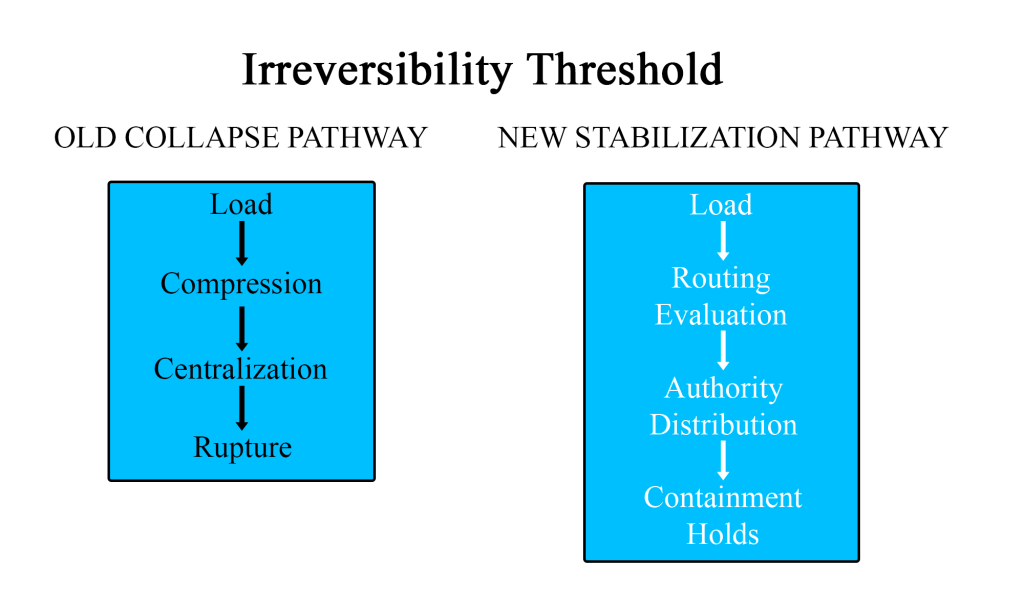
Systems do not return to prior structure.
They repeat collapse or hold under load.
Relief vs Irreversibility
Relief reduces pressure.
Irreversibility changes response to pressure.
After rupture, relief produces temporary stability:
• load decreases
• conflict reduces
• exposure narrows
• recovery increases
These conditions reduce strain.
They can resemble structural improvement.
When load returns, structure reveals itself.
If escalation reflex activates as before, structure has not changed.
Irreversibility is not morale.
It is reflex change under load.
Structural Test 1 — Reflex Stability
Previously, destabilization triggered:
• escalation acceleration
• authority centralization
• routing convergence
• recovery collapse
After reconfiguration, this sequence does not activate automatically.
Under similar pressure:
• pause precedes consolidation
• routing evaluates
• authority remains distributed
• escalation density remains low
The collapse pathway does not activate.
Structural Test 2 — Exposure Expansion
Exposure increases after reconfiguration.
If structure holds:
• admission remains deliberate
• coordination density increases gradually
• commitments remain sequenced
• recovery remains protected
Exposure increases without recreating compression.
If exposure growth recreates overload, containment has not expanded.
Structural Test 3 — Span Expansion
Span increases responsibility and coordination load.
If structure holds:
• decision rights remain distributed
• escalation thresholds remain elevated
• local ownership absorbs pressure
• authority does not reconverge
Span expands without congestion.
If span recreates centralization, structure has not changed.
Structural Test 4 — Compression Response
Compression returns under sustained load.
The question is whether it narrows operational range.
If structure holds:
• escalation thresholds remain stable
• recovery clears propagation
• authority remains distributed
• operational rhythm holds
Compression appears.
Containment absorbs it.
If compression recreates urgency, centralization, and recovery collapse, the prior architecture remains active.
Containment Contraction
When containment contracts, stabilization may simplify.
Authority may temporarily reconverge.
Escalation may accelerate.
Dominant CORE vectors may intensify.
This reflects reduced containment capacity, not identity change.
When containment expands again, stabilization redistributes.
Stage 10 differs:
Distributed containment prevents reconvergence unless structure changes.
The Irreversibility Threshold
Irreversibility does not remove pressure.
Load continues entering.
Conflict continues appearing.
Commitments continue fluctuating.
Irreversibility means pressure no longer reproduces collapse.
Indicators include:
• reflex sequencing remains stable
• authority remains distributed
• recovery clears propagation
• exposure does not recreate compression
When these persist across repeated cycles, structure has stabilized.
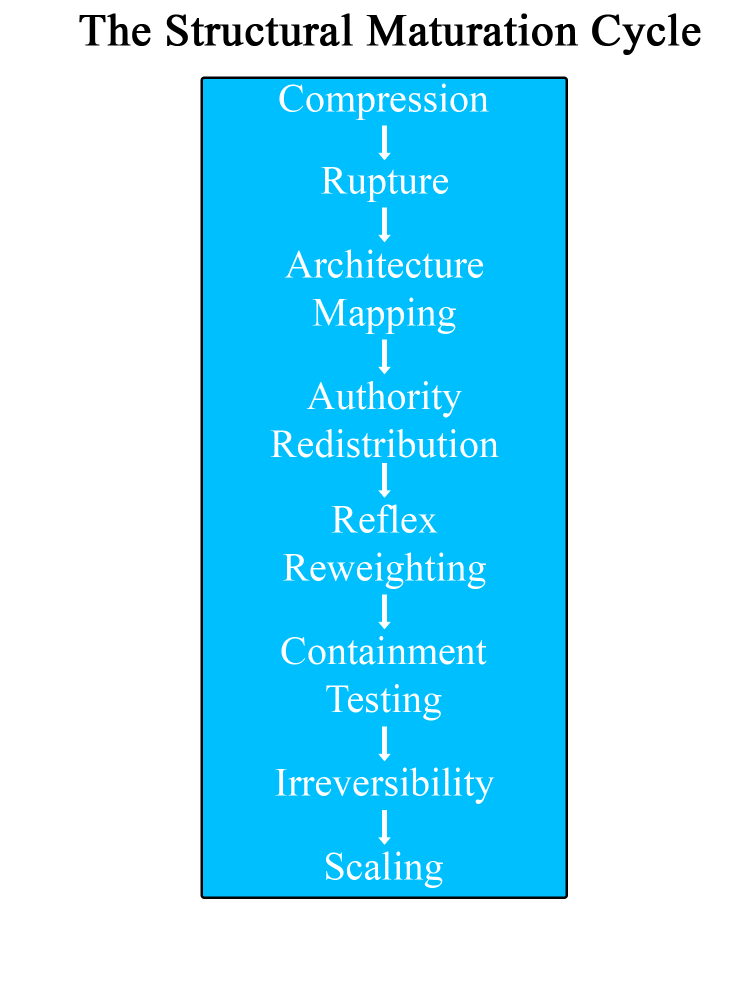
Why Irreversibility Matters
Rupture produces insight.
Irreversibility produces change.
Without irreversibility:
• escalation reflex reactivates
• authority reconverges
• span expands without redistribution
• recovery collapses
Cycles repeat.
Irreversibility marks the end of repetition.
The collapse pathway remains visible.
It no longer activates.
Structure has changed.
Containment has expanded.
The system now operates under higher load without reproducing rupture.
Final Principle
When similar pressure does not recreate collapse,
irreversibility has been achieved.
Containment expansion is permanent.
Chapter 10 — Scaling
System Sequence
CHAPTER OVERVIEW
Scaling follows structural sequence—authority, buffer, exposure, connection, velocity—allowing growth without collapse by expanding containment and preventing compression from reemerging under increased operational load.
COMPRESSION
↓
RUPTURE
↓
CYCLE FORMATION
↓
RECONFIGURATION MODEL
↓
ARCHITECTURE MAPPING
↓
AUTHORITY REDISTRIBUTION
↓
REFLEX REWEIGHTING
↓
CONTAINMENT TESTING
↓
IRREVERSIBILITY
↓
►SCALING
About This Chapter
This chapter defines how scaling occurs after reconfiguration stabilizes.
Growth follows a structural sequence.
If demand increases before structure stabilizes, compression returns.
Scaling expands authority, buffer, exposure, and velocity in sequence.
Containment holds as load increases.
Structural Sequence for Scalable Growth
Reconfiguration does not prohibit growth.
It changes the order in which growth occurs.
Scaling must follow structural sequence.
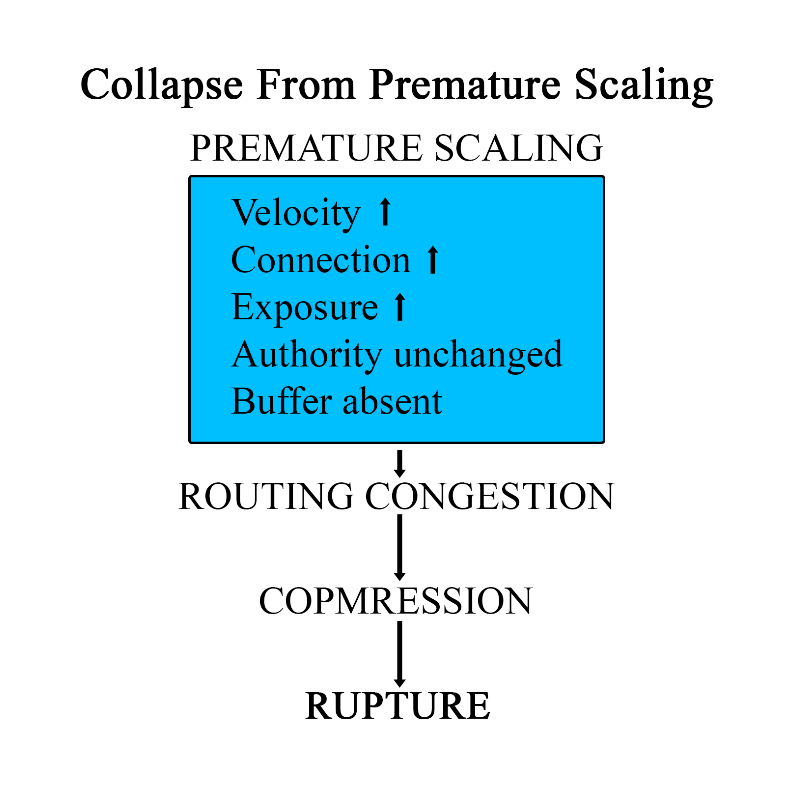
If scale precedes structure, collapse repeats.
The sequence is fixed:
Authority → Buffer → Exposure → Connection → Velocity
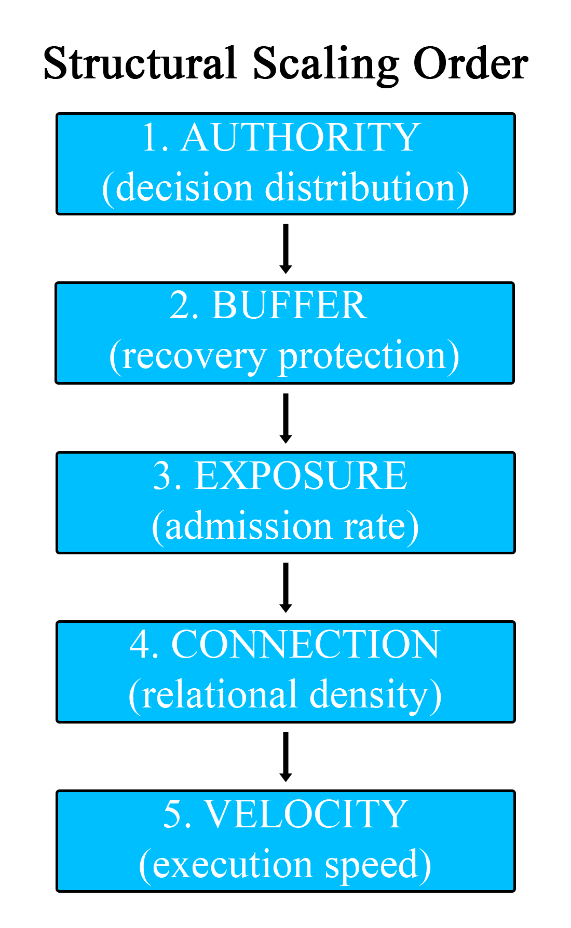
When this order is respected, containment expands without recreating compression.
Authority Precedes Demand
Before demand increases, authority is redistributed.
The system does not scale by centralizing decisions.
It scales by clarifying ownership.
• decision rights remain local
• escalation thresholds remain elevated
• central authority does not reconverge
• routing pathways remain distributed
Authority stabilizes before demand increases.
New load does not collapse into a single point.
Buffer Precedes Exposure
Before exposure increases, buffer widens.
The system preserves:
• recovery windows
• transition intervals
• operational pause between high-load domains
• protected reset periods
Buffer is not created after growth.
It is created before growth.
Recovery does not collapse during expansion.
Exposure Expands Gradually
Only after authority and buffer stabilize does exposure expand.
Commitments are added deliberately:
• initiatives are evaluated structurally
• admission rate increases gradually
• load is sequenced rather than layered
• capacity is evaluated before acceptance
Exposure expands without overwhelming containment.
Connection Expands Modularly
Connection increases compression risk when it expands indiscriminately.
Systems scale connection through modular expansion:
• distinct functional domains
• clear authority boundaries
• limited overlap between high-load systems
• defined communication pathways
Connection distributes.
It does not reconverge.
Velocity Increases Last
Velocity is the final variable.
Only after:
• authority remains distributed
• buffer remains intact
• exposure stabilizes
• connection distributes
does velocity increase.
• decision speed increases selectively
• execution tempo rises without coordination overlap
• urgency remains contextual
Velocity increases without creating time distortion.
The Result — Scale Without Collapse
When scaling follows structural sequence:
• escalation remains filtered
• recovery exceeds propagation
• authority does not reconverge
• span expands without congestion
• compression does not narrow operational range
Containment bandwidth expands.
The system carries more without instability.
The Proof
Scaling is validated when:
• responsibility increases without authority centralization
• connection expands without coordination congestion
• velocity increases without time distortion
• buffer remains intact under rising demand
• prior rupture conditions do not reappear
Containment has widened.
Growth without collapse is the final validation of reconfiguration.
Conclusion
Containment Expanded
You have observed the mechanics of system rupture and structural maturation.
Rupture is not poor leadership.
It is not cultural weakness.
It is containment failure under sustained operational load.
Throughout this system, the same sequence appears:
Load enters.
Pressure propagates through decisions, coordination pathways, and relationships.
Compression forms when recovery cannot clear that pressure.
Containment narrows.
Rupture occurs.
Rupture is the visible moment when containment reaches zero.
What follows rupture determines whether cycles repeat or containment expands.
Relief reduces pressure.
Reconfiguration redesigns structure.
Only structural reconfiguration expands containment.
If structure does not change, rupture repeats.
Under sustained load, repetition accelerates.
Compression forms beneath strong performance.
Authority centralizes.
Recovery shortens.
Coordination tightens.
Operational time distorts.
From the outside, the system may appear efficient.
Internally, tolerance narrows.
Rupture interrupts this sequence.
Interruption does not produce maturation.
Only structural change produces maturation.
The change is structural.
Authority redistributes.
Routing reorganizes.
Escalation thresholds recalibrate.
Recovery expands.
Buffer becomes protected.
When these changes stabilize under renewed load, containment expands.
The system can now absorb pressure that previously produced compression.
Expansion does not occur through effort alone.
Effort increases load.
Structure determines containment.
Maturation is therefore architectural.
Containment expands through cycles.
Structure contracts.
Routing reorganizes.
Authority redistributes.
Stabilization follows.
Each cycle increases the system’s ability to absorb pressure without collapse.
Stages describe this expansion:
containment formation, containment expansion, and containment integration.
This progression is not guaranteed.
Systems may stabilize within limited containment depending on load, placement, and exposure.
Growth occurs when containment expands faster than pressure accumulates.
When recovery remains equal to or greater than propagation, stability holds.
At later stages, stabilization distributes across the system.
Authority no longer converges at a single point.
Escalation density decreases.
Routing remains flexible.
Pressure clears before compression accumulates.
Containment holds across larger spans of responsibility and coordination.
Balanced stabilization becomes possible only after containment matures.
Balance is not the method.
It is the result.
The governing principle is structural:
Pressure will always exist.
The question is whether containment expands faster than pressure accumulates.
If containment does not expand, rupture repeats.
If scale increases, rupture accelerates.
If containment expands, pressure becomes manageable.
This is the difference between cycles and maturation.
Rupture exposes structural limits.
Reconfiguration redesigns structure.
Containment either expands — or it does not.
There is no return to previous structure.
The system either repeats collapse or stabilizes at a larger scale.
When structure becomes visible, instability becomes predictable.
Compression can be observed.
Authority congestion can be mapped.
Recovery collapse can be corrected.
Routing can be redesigned.
Clarity transforms rupture from surprise into signal.
The work of maturation is not managing behavior.
It is redesigning the structure through which pressure moves.
When structure changes, behavior follows.
The system stabilizes because it can now absorb the load.
IRREVERSIBILITY LAW
Once containment expands and holds under load,
previous collapse pathways do not reactivate under the same conditions.
If collapse repeats under the same conditions,
containment did not expand.
Containment has expanded when similar pressure returns and the prior collapse pathway no longer activates.
Structural change has held.
Development is not defined by performance.
It is defined by containment.
Systems do not mature by avoiding rupture.
They mature by reorganizing structure so rupture no longer occurs under the same conditions.
Containment expands through structural change.
Structural change is confirmed under repeated load.
When the prior collapse sequence no longer activates, change is permanent.
At full containment, the system does not become something new.
It reveals what the structure was always capable of holding.
This is containment expanded.
You now see that it is possible.
Reconfiguration changes structure under rupture.
Design defines structure before pressure returns.
Reconfiguration follows failure.
Design prevents repetition.
To see how this structure activates and operates in real time,
continue into book four THOS System Design.
STRUCTURAL CONTINUITY
Across compression, rupture, and reconfiguration, one condition remains constant.
Structure follows sequence.
When sequence compresses, rupture occurs.
When sequence repeats, cycles persist.
When sequence reorganizes, containment expands.
The system does not fail randomly.
It follows structure.