
Gateway Into THOS
Table of Contents
INTRODUCTION — GATEWAY INTO THOS
CHAPTER 1 — IDENTITY IS UNIVERSAL
CHAPTER 2 — PRESSURE, RUPTURE, & RECONFIGURATION
CHAPTER 3 — AUTHORITY REDESIGN
CHAPTER 4 — BOUNDARY DEFINITION
OPTIONAL APPENDIX INSTALL
INTRODUCTION — Gateway Into THOS
When days feel full, when decisions continue, when outcomes depend on action—this is
not isolated. It is the system operating.
Most attempts to manage this focus on effort. More work, more communication, more
attempts to stay ahead. Sometimes this helps. But the same problems return.
This book begins with a simple idea: what happens is not random. It follows a
pattern.
That pattern can be seen by how pressure moves—what enters, where it goes, and
what happens to it.
This is not a book about behavior. It is a book about structure. It does not add more to
manage. It makes what is already happening visible.
Once that is visible, a choice exists.
Continue managing pressure.
Or change how it moves.
CHAPTER 1 — Identity is Universal
Everything that exists is a system. There are not separate teams—there is one system
made up of domains and roles. A system is what receives input, processes it, and
produces output.
Input enters the system in four forms: information, demands, resources, and conditions.
On their own, these are neutral. They become pressure when they require action.
Pressure is not the input itself. Pressure is created when something must be decided,
moved, maintained, or aligned.
This appears as responsibilities that must be carried, decisions that must be made,
expectations that must be met, and tasks and people that must stay aligned. When
these require action, pressure exists.
When days feel full, when decisions continue, when outcomes depend on
action—pressure is being processed.
The size of a system can change, but the structure does not. A system is defined by
what it carries and how it processes what it carries. Whether it is one role or many, if it
must process pressure, it follows the same rules.
A system is not a single piece. It is made up of layers that work together. These layers
shape how pressure is received, processed, and expressed.
Inside a system, these layers include input (what comes in), processing (what is worked
on), patterns (what repeats), CORE (how pressure is stabilized), and output (what
comes out). These layers are always active.
As systems expand, these same layers appear as roles, functions, domains, and
structures. The form changes, but the function does not. Multiple layers always interact
to process pressure.
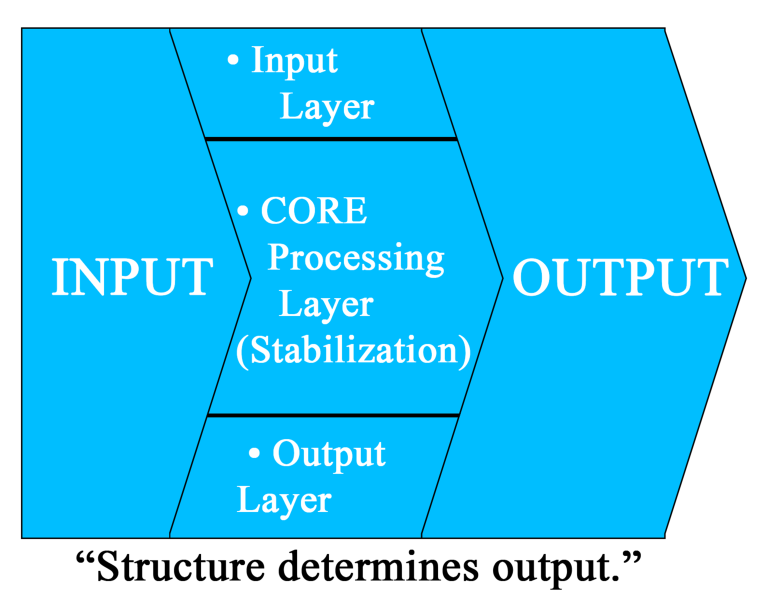
Every system performs three functions: it receives input, processes pressure, and
produces output.
Processing occurs in sequence. The system interprets what the input is, prioritizes what
matters, routes where it goes, and responds with action.
Output is what the system produces—decisions, actions, results, and outcomes. This
process is continuous.
Output is not random because processing is not random. Structure determines how
input is interpreted, how pressure is distributed, and how responses are produced.
Gateway into THOS
Two systems can receive the same input and produce different outcomes because their
structures distribute and process pressure differently.
If structure spreads pressure effectively, processing remains stable and output remains
consistent. If structure concentrates pressure, processing becomes strained and output
becomes unstable.
The outcome is not decided at the moment of output. It is determined by how the
system is structured to process pressure.
The system is the foundation. Pressure, strain, and change all occur within it.
If the system is not understood, events appear random. If the system is understood,
outcomes become predictable.
Every identity is a system processing pressure. What it produces is not by chance. It is
determined by structure.
CHAPTER 2 — Pressure, Rupture, & Reconfiguration
All systems carry pressure. Pressure comes from what must be
processed—responsibilities, decisions, expectations, and coordination. As these
increase, pressure increases. Pressure is constant.
Pressure moves through the system. It does not stay in one place. It flows through
roles, layers, and connections. It must be absorbed, distributed, or cleared.
When pressure is absorbed, it is held within the system. When it is distributed, it
spreads across the system. When it is cleared, the system resets after processing. If
these do not occur effectively, pressure remains.
When pressure remains, it accumulates. Work may complete, but residual pressure is
still carried. New pressure enters before previous pressure has cleared. Layers build
while the system continues to operate.
As accumulation increases, strain forms. Strain is the condition where pressure is no
longer processed cleanly. The system continues to produce output, but requires
increasing effort to do so.
In response, the system adjusts. Effort increases, control tightens, and coordination
expands. More work is required to maintain the same output. These responses stabilize
the system temporarily, but do not remove accumulated pressure.
When structure can no longer carry the accumulated pressure, rupture occurs. Rupture
is not failure. It is the point where structure can no longer contain what it is carrying.
At rupture, what was previously contained becomes visible. Delays, conflict, breakdown,
and overload appear. Accumulated pressure is no longer held within the system.
After rupture, pressure drops. Activity slows. Relief appears. Strain decreases, creating
the appearance of recovery. The relief is real, but the structure has not changed.
If structure remains the same, the pattern returns. Pressure enters again, follows the
same paths, concentrates in the same places, and produces the same outcome.
The sequence repeats: accumulation, strain, rupture, relief, repeat
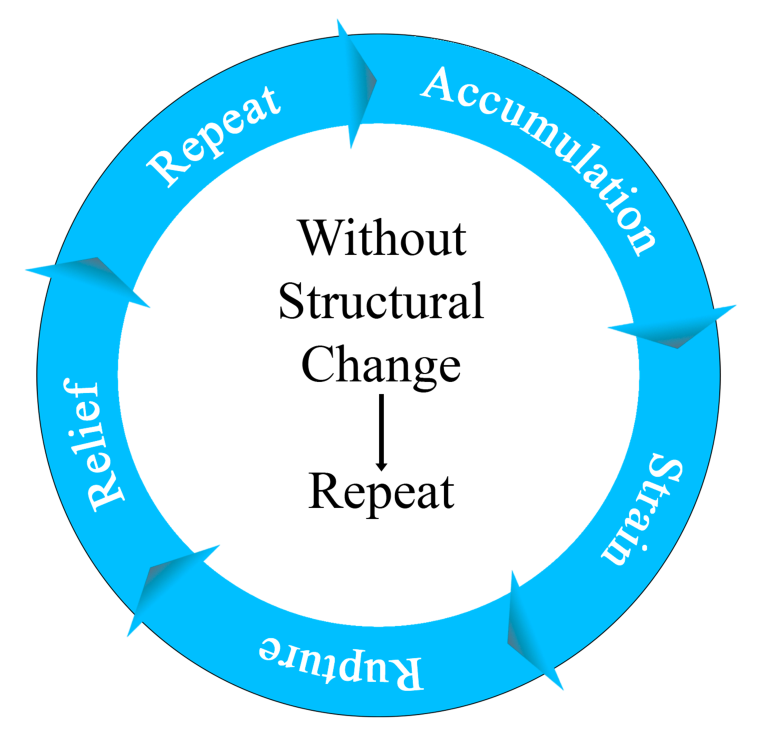
The system has not changed. It has reset.
For the outcome to change, the structure must change.
This means changing how pressure enters the system, how it moves through it, and how it clears.
When these change, pressure no longer follows the same paths. It distributes across the system instead of concentrating in one place. Recovery becomes effective, and pressure clears instead of carrying forward.
The same pressure now produces a different result.
This change in structure is called reconfiguration.
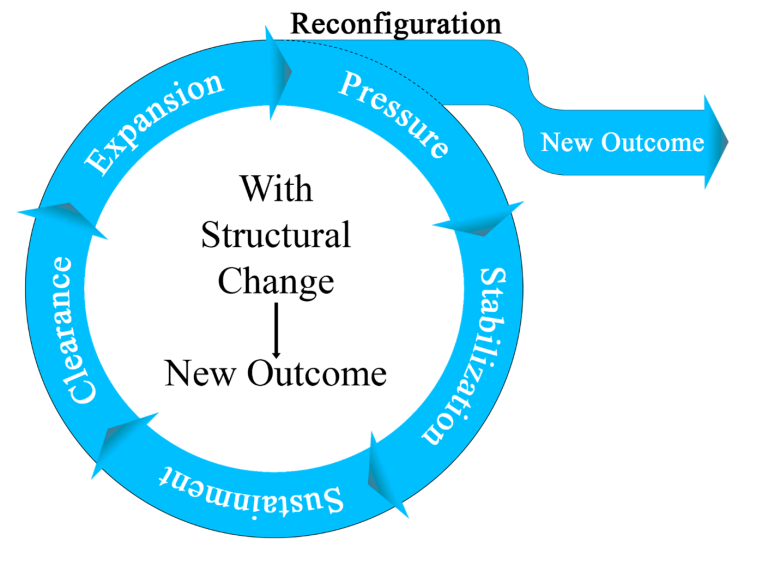
Reconfiguration does not remove pressure. It changes how the system handles it.
Rupture reveals the limit of structure. Reconfiguration changes that limit.
Without reconfiguration, the cycle repeats. With reconfiguration, the system can carry more pressure without rupture.
CHAPTER 3 — The Universal Law
Every system follows the same rule. Pressure enters, pressure moves, and pressure either clears or accumulates. There are no other outcomes. All structure follows a sequence.
It does not form randomly.
This sequence is continuous. It does not pause and does not depend on awareness. Every system is always processing pressure.
Pressure moves according to structure. Structure determines how pressure flows, where it concentrates, and what happens to it.
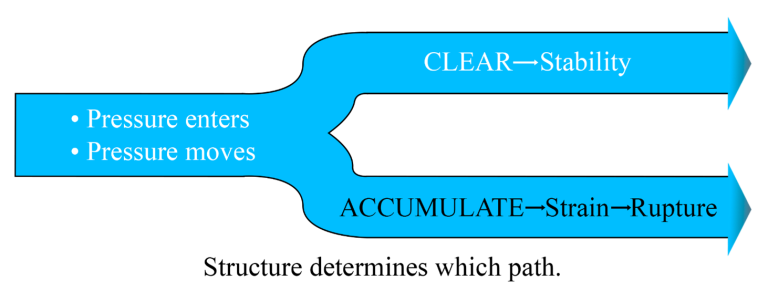
There are only two results. If pressure clears, the system resets and stability holds. If pressure accumulates, strain forms and effort increases to maintain output. If accumulation continues, rupture occurs. After rupture, the system either resets or reconfigures, and the sequence continues.
This pattern applies at every scale. The size of the system changes. The sequence does not.
The cause is not behavior, effort, communication, or motivation. These can influence output, but they do not change the sequence. The cause is structure.
Structure determines how pressure moves, where it concentrates, whether it clears, and what the system produces. Two systems can receive the same pressure and produce different outcomes because their structures process pressure differently.
Effort can sustain output for a period of time, but it does not change how much pressure the system can carry. It extends the sequence. It does not alter it.
The sequence continues until structure changes. If structure remains the same, the same outcomes return. If structure changes, the outcomes change.
This is the universal law. What repeats is not random. It is structural.
CHAPTER 4 — How THOS Works (Playbook)
Now that the pattern is visible, a decision exists. Continue managing pressure, or change how it moves. This chapter shows how to change its movement.
THOS is used to do three things: see how pressure moves, locate where it concentrates, and redesign how it clears. If pressure distributes, the system holds. If pressure concentrates, the system ruptures. Most systems try to manage pressure. THOS changes how it moves
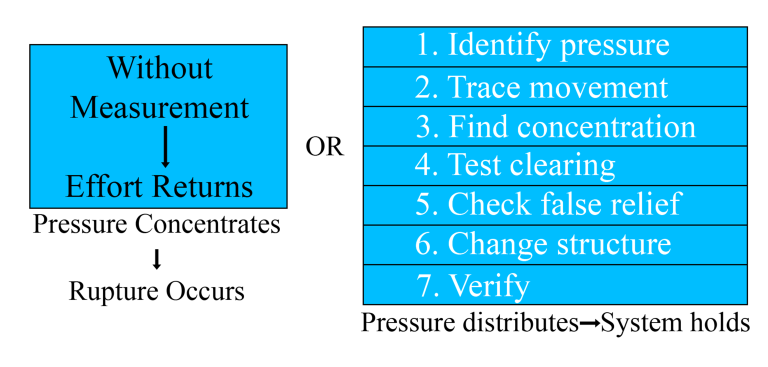
Start by identifying pressure. Pressure is everything the system must handle—responsibilities, decisions, expectations, and coordination. It is already being carried.
It becomes visible when effort increases to maintain output, when the same problems return, when movement slows at specific points, or when more effort produces less movement. If effort is rising just to maintain output, pressure is accumulating.
Next, trace how pressure moves. Pressure does not stay in one place. It follows structure. Look at where decisions go, where movement slows, where waiting occurs, and where problems return. Patterns will appear. Repeated bottlenecks, overloaded roles, looping flow, and delays at the same points reveal where pressure concentrates.
Then identify where it concentrates. Where pressure slows, it builds. Look for too many decisions in one place, constant approvals, repeated escalations, and increasing communication with decreasing clarity. If part of the system feels heavier, moves slower, or requires more effort, pressure is concentrating there.
Next, test whether pressure clears. Pressure must clear or it carries forward. Observe whether the system resets after activity completes or if strain remains. If output carries forward, backlogs persist, the system begins already behind, or relief only occurs when activity stops, pressure is not clearing—it is accumulating.
Do not misread relief. After breakdown, demand drops and the system feels better. This is relief, not change. When pressure returns, observe the pattern. If the same sequence returns, the structure has not changed.
At this point, most attempts focus on behavior. Effort increases, communication expands, and adjustments are made. But structure remains the same, and the outcome returns. The issue is not effort. The system is not fully visible.
Without structural clarity, pressure is misread, effort is misapplied, load types remain mixed, and capacity is assumed rather than measured. Pressure continues to concentrate, accumulate, and repeat.
THOS makes structure visible. It shows how pressure enters, how it moves, where it concentrates, and what clears. It separates what is currently mixed—types of pressure, sources of load, and limits of capacity. It reveals what the system is doing, not what it appears to be doing.
When structure becomes visible, the approach changes. Instead of managing pressure, pressure is reconfigured.
Reconfiguration changes how pressure enters, how it moves, and how it clears. As structure changes, pressure distributes across the system instead of concentrating. Recovery becomes effective. The same pressure produces a different result.
After changes are made, verify them. Under similar demand, observe whether pressure still concentrates or if it moves and clears. Structure has changed when less effort produces the same output, delays decrease, decisions move faster, and recovery resets the system. If pressure moves differently, the system is different.
One rule remains: structure cannot be fixed with effort. Concentration cannot be outworked. Misalignment cannot be resolved through communication alone. Pressure must be moved differently.
The pattern is now visible. Most recognize it and continue managing pressure.
To change the outcome, two paths exist.
The first is to make structure visible through the CORE Assessment—how pressure is stabilized, how much can be carried, and what is being carried.
The second is to go deeper into the THOS system—how pressure spreads, how structure contains it, and how systems stabilize under load.
Without THOS, effort increases and the pattern repeats. With THOS, the system changes.
Continue managing pressure without structure, or manage it by changing how it moves.